Dutch winter food: hutspot
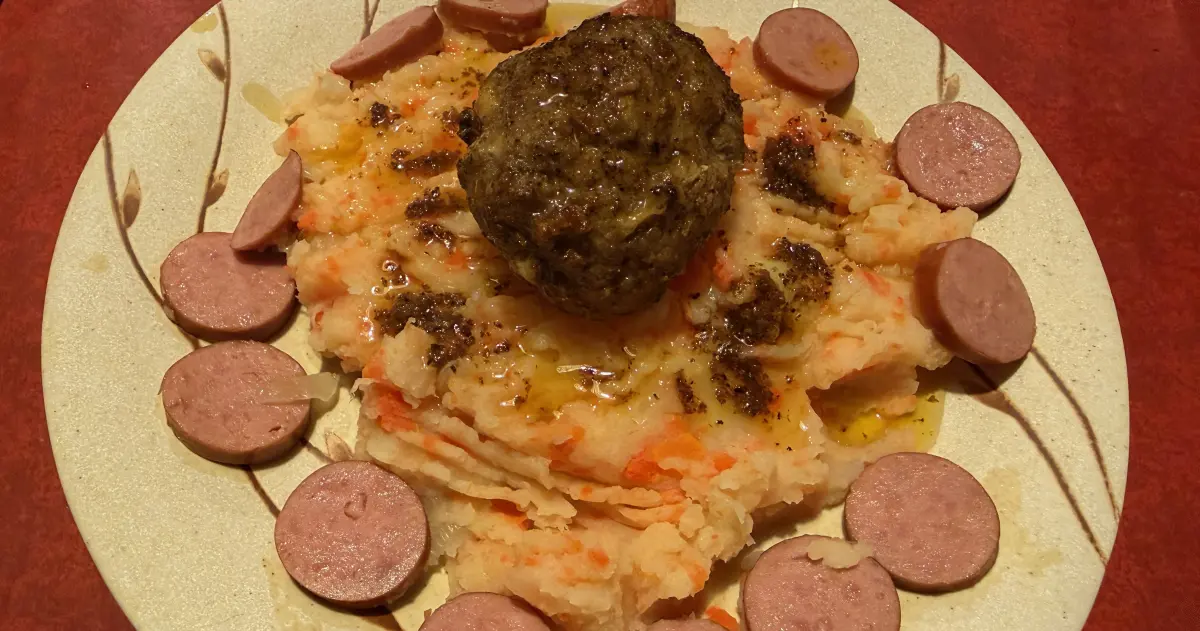
Tonight I felt like a last shot at eating, and thus cooking, a typical Dutch winter dish. Winter is rapidly disappearing here in CA (it was 70F today), and because of tradition, I just don’t make dishes like this when the weather is not wintery. I made an exception today, just because I did not see another opportunity on the horizon.
History
According to legend, during the siege of Leiden in the Eighty Years’ War, the Spanish soldiers had to save their lives at the last moment when Dutch liberators breached the dikes of the lower-lying polders surrounding the city (a technique employed in later wars as well). This flooded all the fields around the city with about a foot of water. As there were few, if any, high points, the Spanish soldiers camping in the fields were essentially flushed out. The soldiers left behind potato bits from their cooking and some other ingredients, and that is supposedly where the name comes from.
Hutspot is traditionally potatoes, onions, and carrots, cooked with “klapstuk” (Dutch) in the same vessel. Klapstuk is a cut of beef from the rib section. It is marbled with fat and responds well to slow cooking in hutspot. If klapstuk is unavailable, smoked bacon is commonly substituted. The carrots used are generally of the type known as winterpeen (winter carrots), which give the dish its distinctive flavor that ordinary carrots cannot match.
The term hutspot (which can be roughly translated as “shaken pot”) is similar to the English term hotchpot and Middle French hochepot, both of which are used to identify a type of meat-and-barley stew that became synonymous with a confused jumble of mixture, later referred to as ‘hotchpotch’ or ‘hodge-podge’. In noting the etymological connection, the Oxford English Dictionary records ‘hochepot’ as a culinary term from 1440, more than a century before the Siege of Leiden. In Melibeus (c1386), Chaucer wrote, “Ȝe haue cast alle here wordes in an hochepoche”, but that early use probably referred to its legal sense in English law (recorded from 1292) as a blending of properties. Later uses certainly referred to its culinary sense.
This dish is most often eaten in late fall and winter, and sometimes in early spring. It is a hearty meal, originally designed for people much more physically active than 21st-century man. The dish often tastes even better the second day!
My version
The three main ingredients of the dish are potatoes (I use Russet), coarsely chopped onion, and carrots. All three are cooking in a single pot with salt, peppercorns, and bay leaves added. When the potatoes are cooked through, the rest is ready too. Excess water is poured off (some reserved), butter is added, perhaps some of the left-over cooking liquid and/or milk, and then everything is mashed, but left a little chunky.
My family is used to getting this dish not with klapstuk, but rather with “rookworst” and/or a “gehaktbal.”
Rookworst is Dutch for smoked sausage, and it is a specific type of sausage (famous in the Netherlands, available from Hema or the Unox brand). US import laws make it impossible to get these here, but my reasonable approximation is a smoked pork sausage from Hillshire Farms.
A “gehaktbal” is a meatball. “Gehakt” means “having been chopped,” and refers to the ground beef, and sometimes pork, used to make them. Traditional versions use “half en half,” which refers to half beef, and half pork, and not to the coffee creamer. I often make them this way, but sometimes I cannot get the ground pork and make all-beef versions, like today. Ingredients include eggs, bread soaked in milk, spices, and additional bread crumbs as needed. The meatballs are lightly seared in a Dutch oven, then finished by braising. The cooking liquid (water added during braising) becomes the gravy you serve with the dish.
Healthy, it is not! Yummy it is!