Buying hard disks for a NAS: Not an easy task
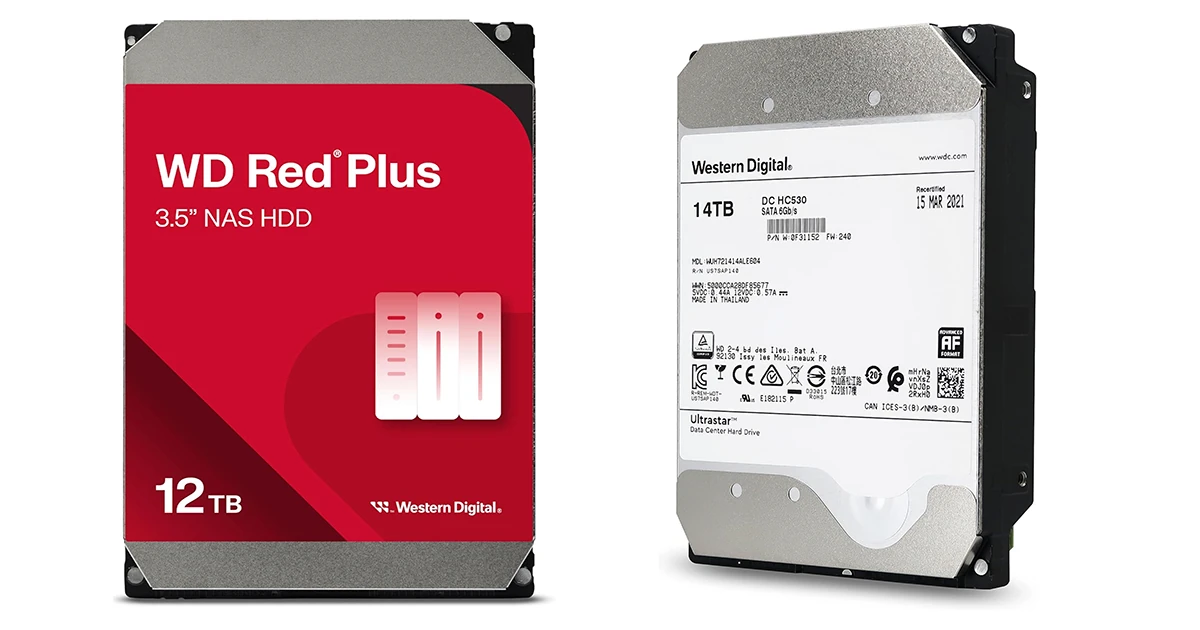
In February, I bought a new NAS enclosure to replace my three-year-old_ ReadyNAS devices. Of course, I needed to also purchase disks to go inside.
I wanted four 12TB drives (or slightly larger) and did a bunch of googling and watching YouTube reviews to determine which drives might be the best to buy.
Attempt #1
I settled on Western Digital WDC_WD120EFBX (12TB), principally because they are advertised for NAS usage, and are helium-filled, which should make them quieter.
That turned out to be easier said than done. I found a vendor (Brute Force Networks) that advertised them on Amazon as available. I ordered them, and after they arrived, I was so eager that I ripped open the sealed anti-static bags and installed them. Never looked closely. I did notice they came in a plain box, not a manufacturer’s box. That should have been a signal!
Soon, I figured out that two of the four drives received were the wrong model: WDC_WD121KFBX. I contacted the vendor, and they apologized and said they would send replacement units. It took them over a week to ship the replacements (this, too, was a signal, not recognized at the time). They admitted one of the two replacements did not pass a test, so it would have to come later.
The fourth drive came in a manufacturer’s box, with the correct part number on the outside, but inside was the wrong model. Another signal!
Several weeks later, this concluded with them admitting they were unable to source the WDC_WD120EFBX and suggesting I keep the one “different” drive. They refunded one drive for my trouble and the delays. Sounds reasonable.
Then I finally got “smart” and ran a program called smartctl to extract all kinds of information from each drive. I found out that three of the four drives had already been used for over 25,000 hours (about 3 years or more). So, these drives were not even new (although the original product offer did not mention refurbished or anything like it).
Next, I looked up the serial numbers on these drives and tested their warranty status with Western Digital. I found:
| Status | Description | Expiration Date |
|---|---|---|
| OUT OF WARRANTY | WD120EFBX-68B0EN0 WDLEOA12 12.0 TB 16HD RED PLUS HGST | 29-May-2024 |
| IN LIMITED WARRANTY | WD120EFBX-68B0EN0 WDLEOA12 12.0 TB 16HD RED PLUS HGST | 25-Apr-2026 |
| IN LIMITED WARRANTY | WD121KFBX-68EF5N0 WDLEOA12 12.0 TB 16HD NAS HGST | 13-Feb-2028 |
| OUT OF WARRANTY | WD120EFBX-68B0EN0 WDLEOA12 12.0 TB 16HD RED PLUS HGST | 21-May-2024 |
These drives come with a five-year warranty, and I pulled them out of the NAS and finally saw the manufacturing dates on the labels, which confirmed they were several years old.
The vendor agreed to take them back and would refund me the other three. Interesting because originally I got some compensation for my trouble, but now, when it is all said and done, I will have no compensation.
Attempt #2
I determined that the original model I wanted is no longer manufactured (which explains the used units). Helium-filled units, still the option I wanted, are now available only in more expensive enterprise-rated or pro models. It seems the HGST WD Ultrastar DC HC530 14TB would fit the bill. These drives are expensive, but I found an offer on refurbished drives with a 5-year warranty for $299. Seemed like a good deal, so I ordered them.
A week later, they arrived, again not in the manufacturer’s packaging, but that was expected this time. I had read that many folks have good results with officially refurbished drives, but a thorough test before use was advised.
The four drives received were all used; no surprise there. Interestingly, their “powered on hours” are listed as zero. But the counter for the total number of blocks written indicated many petabytes had been written. Testing results showed that one of them had intermittent electrical failures, two others had unrecoverable writing errors in the recent past (at age 4.5 years or older), and the fourth also failed a test.
It turns out that special software can reset the power-on hours counter, but the error logs and other data cannot be erased. A casual inspection will show the zero powered-on hours, and users may feel comfortable. The bad blocks on the drive may well be in a location where a typical user would have to write a lot of data before those blocks are “touched,” triggering a problem. Consequently, users who are less savvy will buy the drive, not notice, and perhaps not every have a problem within the five years.
In such a scenario, one could argue that this was a good deal: cheap(er) hard drives, and no problems. However, when you put drives like these in a NAS, odds are you will (a) be storing a lot of information, and (b) NAS software may write all over the disks. This increases the odds of a problem being “hit.” > Furthermore, in a NAS application, the drives will be powered up 24/7, further increasing the likelihood that problems worsen, which in turn increases the likelihood of encountering the problem.
One could still argue that, as long as a RAID configuration of some sort is used, the data is still safe, and that might be true, until the problem develops. At that point, you are looking at a minimum of 10 days to acquire a replacement drive, receive it, swap it out, and re-sync it. Until that is accomplished, you have no redundancy (in case another drive fails), or perhaps one more disk of redundancy. “Resilvering” drives puts a lot of stress on the remaining drives, further increasing the odds of a double or triple failure and actual data loss.
Yes, backups are there to handle that scenario, but for me, only as a last resort (I do make those backups every night), because a restore from cloud storage is a long, tedious process.
So, it turns out that promising a five-year warranty is not an indication of quality, but rather a statistical business decision. Many users lack the savvy to recognize they are buying heavily used drives that may already show signs of partial failure. So, as long as such users never encounter a problem and do not attempt a warranty return within the first five years, this is good advertising that makes the business feel legit.
Also interestingly, these drives were sold on Amazon and had an Amazon label of “Excellent”. Amazon has such “quality” labels for refurbished products, but this experience makes me question what those labels are based on. Possibly just a statement by the vendor.
Attempt #3 (hopefully final)
So now I have soured on the used and refurbished disk market to the point that I no longer trust it. There probably are some manufacturer-refurbished units out there that can be trusted, but they are basically too hard to find.
I have now ordered four brand new WD Red Pro WD161KFGX models (16TB). These are basically big brothers to the one WDC_WD121KFBX (12TB) I received for attempt #1. I had determined that the unit was helium-filled and quiet enough, but it, too, is old and no longer manufactured. Its newer available model is no longer helium-filled. Neither is the 14TB model, but I found that the 16 TB model is still helium-filled (they call it HelioSeal).
While this is more capacity than I originally thought I needed, it will probably still get used eventually. There is an unwritten law of hard disks: no matter the size, all available capacity will eventually be filled!
These four disks in RAIDZ2 configuration will give me 32TB of usable space!
Vendors used
Brute Networks
Brute Networks is a third-party seller operating on marketplaces like Newegg, Amazon, and Walmart. They specialize in refurbished or “re-certified” IT hardware—including hard drives, memory, and processors—compatible with major OEM brands like Cisco, Dell, and HP.
Had I known I would get used disks, I would not have bought them, but the product I bought on Amazon was not labeled refurbished or re-certified. Later, I did find comments that paralleled my experience, so this was not a unique situation.
I have yet to return the drives, because I explained I needed new drives first to one-by-one replace them in the NAS. They agreed to that, and I have the return label, so I expect the refund without any problems. It will be another two weeks before I have all four new drives, and then probably another week before I have them all swapped out.
goHardDrive.com
GoHardDrive.com is a La Puente, California-based direct-to-consumer reseller specializing in discounted, refurbished, and manufacturer closeout hard drives, often offering 5-year warranties on renewed drives. Generally, customers in Reddit forums report fast shipping and good warranty support, although some users have raised questions about the “new” versus “refurbished” status of certain drives and have reported potential data privacy concerns.
Here, I knew the hard drives were refurbished. I do not appreciate the “power on hours” counters being reset to 0. The good news is that I had absolutely zero trouble requesting a return and receiving a return shipping label.
Newegg and Adaroma
I decided to buy the brand-new drives available on Newegg, but they limited each buyer to a maximum of 2. So I bought the other two through Adorama, for the same price. It will take until the end of April until I have them all. Both vendors were cheaper than buying direct from Western Digital or through Amazon.com.