Levains Worksheet
Levain (French for “leaven”) is a generic term for a preferment. Most of the time, when the French use the term, they mean what we call a starter, but it could also apply to a poolish, biga, or sponge.
All levains contain flour and water, and sometimes additional ingredients. The main difference between various levains is often their water content. A specific formula may call for a levain with a specified water content, but you may not have one available. This worksheet helps you determine how to handle the situation.
Levain and hydration
Levains are typically characterized by the type of flour used and their hydration level. The hydration level is defined as the weight of water used divided by the weight of flour used. In terms of baker’s percentages, therefore, the hydration level is equal to the baker’s percentage of the water in the formula (this is only true for “straight” formulas). When we speak of water content, we mean the percentage of the overall weight that is water. This is not the same as the hydration. An example is a typical “stiff” levain with 50% hydration. It is maintained by adding flour and water to a piece of mature starter in the ratio of 2:1 (2 parts flour to 1 part water by weight). The water content, however, is \(\frac{50}{100 + 50} = 33⅓%\).
Adjusting a levain for different hydration
If you have a levain at a specific hydration level and want to convert it to another hydration level, start by computing the amounts of water and flour in the piece you are going to “feed.” You know the desired hydration level for the new levain, so if you choose the final weight, you can calculate how much water and flour are needed in total for that levain. Subtract what you already have, and you will know what you need to add.
An example. Convert a “stiff” levain at 50% hydration to a liquid levain at 90% hydration. Assume we start with 45g and want to make the new levain 200g. The starting levain contains 100% flour + 50% water, or 150% total, and thus of the 45 grams, \(45 * \frac{50}{150} = 15\) grams of water, and \(45 * \frac{100}{150} = 30\) grams of flour. The “new” levain needs to contain \(200 * \frac{90}{190} = 94.74\) grams of water and \(200 * \frac{100}{190} = 105.26\) grams of flour. That means we need to add \(105.26 - 30 = 75.26\) grams of flour and \(94.74 - 15 = 79.74\) grams of water.
If you don’t like the idea of making big adjustments to a levain, just do it in steps. In the above example, at one feeding, you could go from 50% to 70% hydration, and in the next, from 75% to 90%.
Adjusting a levain in a two-stage build
Oftentimes, the formula for a bread calls for the use of a particular starting levain to build a specific levain for this bread as a preferment, which then goes into the final dough. If your available starter does not have the correct hydration, you compensate by adding or removing water from the rest of the build levain appropriately. The principle is the same as for adjusting a levain by itself, except that this time, the target weight for the built levain is determined by the formula, and there may be other ingredients.
How to use the worksheet
You will find the following on the “Levains” worksheet (this assumes that levains only contain flour and water):
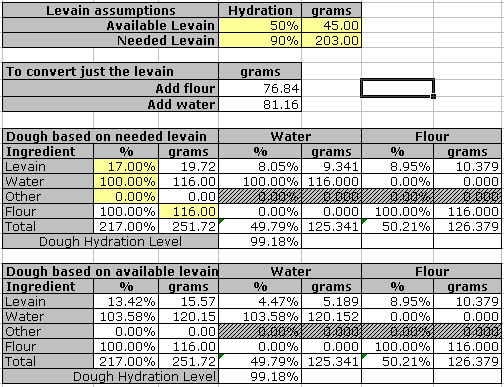
As usual, the yellow cells are where you enter information. Shown here are an available levain at 50% hydration, weighing 45 grams, and a needed levain at 100% hydration, weighing 203 grams.
If you just wish to convert the levain, and feed at the same time, to arrive at the desired weight and hydration, you will need to add 76.84g of flour and 81.16g of water.
The second part illustrates a more common scenario. You maintain a 50% hydration starter, and now you are preparing to make a bread that requires building a levain (possibly with a different kind of flour) at a different hydration. The first block is where you input the percentages for the overall desired levain (based on 17% existing levain and 100% hydration in this step). The second block shows how to adjust the formula to make it work with the levain you have. The amount of flour contributed by the levain is equal in both cases, so the adjustments are made in the dough by adding more flour and more water.