Analysis Worksheet
When a formula uses preferments, it is often hard to see at a glance what the overall composition of a dough is. Hydration of the overall dough determines its stiffness; for example, if some of that hydration comes from preferments, one cannot simply look at the percentage of water in the final dough. A similar situation exists if one or more preferments use salt, etc.
In addition, it is not easy to see the total amounts used of any unique ingredient because an ingredient may be used in both a preferment and the final dough, etc. This makes it a little hard(er) to determine how much of each ingredient is needed before you start baking.
The purpose of the “Analysis” worksheet is to provide you with this information. It presents information separately for each preferment and for the overall dough. Here is an example:
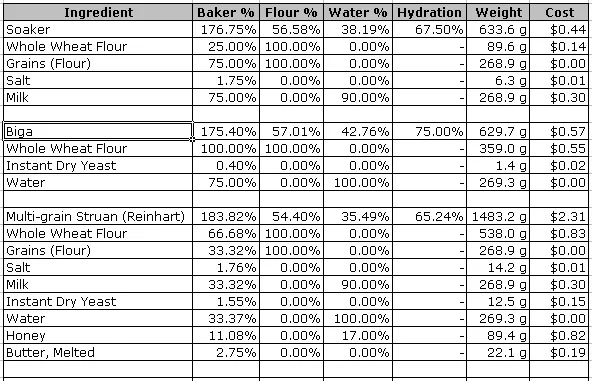
The information on this worksheet is updated whenever the “Recipe” worksheet is updated, and this worksheet is never edited.
Calculation
The analysis is computed by first evaluating it for each preferment. Next, the details for each ingredient in the final dough are determined. If an ingredient refers to a preferment, all necessary information is now available. The calculation proceeds by replacing the single ingredient referring to the preferment with the complete ingredient list from the preferment. Finally, identical ingredient entries are combined so that each ingredient appears only once in the final list.
Based on earlier calculations on the “Recipe” worksheet, weights for all ingredients are known. The “Lookup” worksheet is now used to determine the water content (H2O%, which is NOT the same as hydration) and flour content (Flour%). This is so that these two items can be added for all ingredients in the overall dough. We then obtain the overall hydration by dividing the summed H2O% and Flour% by the summed Formula% (after all, we want flour to be 100%).
In the example “Soaker” preferment, you will notice that the milk only contains 90% water (the rest is called milk solids). The flour contributes 100% out of 176.75%, or 56.58%, and likewise water is 90% times 75% divided by 176.75%, or 38.19%. Thus, the hydration is 38.19/56.58 or 67.5%.
The total liquid contribution to the overall dough is 90% of 268.9 (milk) + 269.3 (water) + 17% of 89.4 (honey), or 526.508 grams. Total flour is 538 + 268.9 = 806.9, so overall hydration is 526.508 / 806.9 or 65.25%.
You can also see that overall salt is 1.76%, which is in the typical range for bread, but not as high as some at 2%. Finally, notice the overall cost of $2.31, dominated by the cost of the flour and honey (and milk). Note that I did not list a specific cost for the additional grains (because the term is rather ambiguous). If you would like to minimize your cost, you can get cheaper flour and honey or substitute them.