Goodbye SunPower PVS6
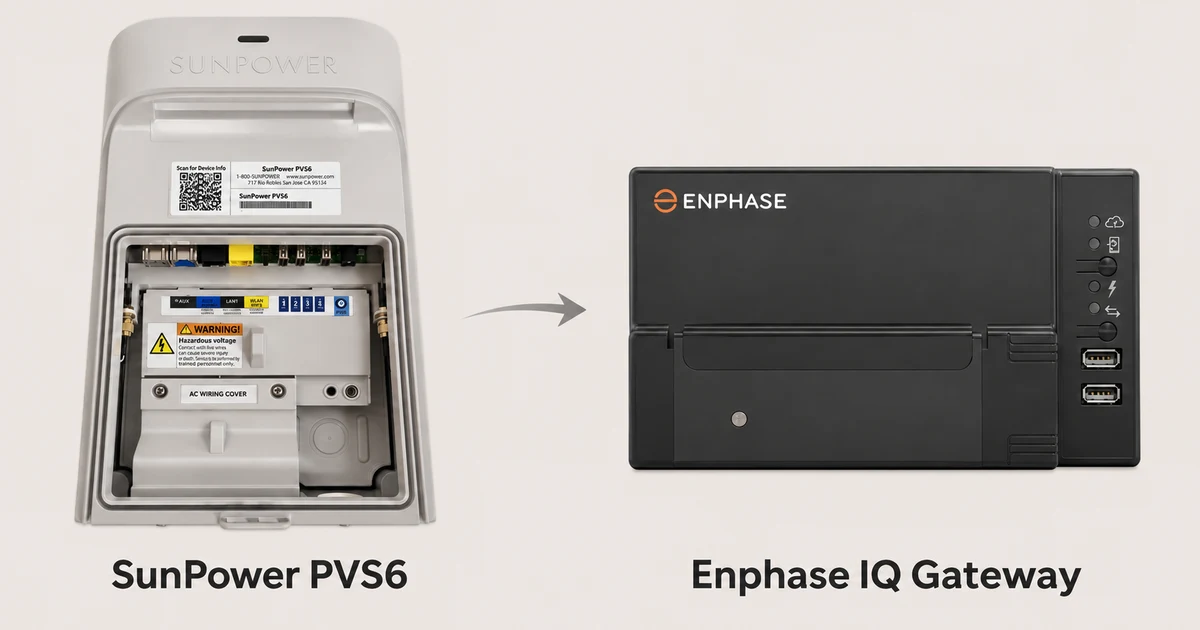
I have written, fairly extensively, about extracting monitoring data from a SunPower PVS5 and PVS6 system. Much of the work I did was supported by testing with a PVS6 that is part of my own solar installation. Now I am about to get rid of that PVS6, which also means I will likely not be producing any more info.
Past Posts
The history
I had a SunPower solar system installed in October of 2021 by a well regarded local installer. The installation involved 24 SunPower panels, with IQ8 micro inverters (an Enphase product, rebranded as SolarBridge). Monitoring was supported by a PVS6 with only production CT clamps installed (consumption was optional and not installed). The rest of my energy monitoring was supported by a Sense system with two clamps for the main supply, and two for the solar production as well.
During the next five years I first gained access to panel level monitoring by working with my installer, who then got SunPower to enable to feature in their portal and mobile app. I found that unsatisfactory and went looking for more direct monitoring solutions.
I found that it is possible to install a small Raspberry Pi inside the PVS to act as a communication bridge between my local WiFi network and the PVS6 support Ethernet interface. That, in turn, allowed access to a local API. Around the same time somebody also produce an integration for Homeassistant, and that completed my local monitoring solution.
Bankruptcy
SunPower Corporation filed for Chapter 11 bankruptcy in August 2024. SunPower customers were left “on their own.” There was no more support available. Those with leased systems were still required to make their payments because the outstanding lease agreements were bought out of the bankruptcy, without the burden of maintenance and support. Those that fully owned their systems were also out of support, but at least were not still sending in money.
If your system was operating normally, there were no immediate worries. This was the case for me. Those with SunVault battery systems, that fairly frequently shut themselves off, where “stuck,” until some individuals with knowledge and tools could offer to help out.
Those with Maxxeon panels (split off from SunPower years before), were guaranteed warranty by Maxxeon corporation. IQ8 micro inverters warranty was picked up by Enphase. But nobody assumed responsibility for the PVS systems.
The monitoring through the portal and mobile app was also in doubt for a while, but those assets were eventually picked up by a new company called SunStrong. The web portal was closed, but the app still works, but now requires a monthly subscription fee (it was free while it was with SunPower). This rubbed more people the wrong way, and even more sought the local monitoring route.
SunStrong did later upgrade the available API in the PVS systems, and reduced, or eliminated the flash card capacity threat. The already worn down cards remained a problem though. They are not field replaceable. Fixing it requires a “new” PVS6.
The problem(s)
The solution worked, but almost nobody knew, at the time, that each API call to obtain data caused a fairly large amount of logging output to be written to the flash card inside the PVS6. That flash card was not up to a large number of writes and, as is the case, over time quickly lost the ability to fully utilize its capacity.
Once the remaining capacity falls below a certain threshold, it is no longer safe to perform firmware updates; they might brick the device. Firmware updates were now coming through SunStrong, and as far as I know, you for sure would not get any if you were not subscribed to their system. I did subscribe, for that very same reason, hoping to get a firmware update so I could use the new APIs and prevent further flash card degradation.
Not so fast, my friend. It turns out my remaining flash capacity was already below some threshold set by SunStrong so I was not receiving automatic upgrades. I was able to convince them to “risk it” one time and did receive an upgrade, but have not since then and I am now several releases behind. That one upgrade that get me access on to the newer API that no longer requires the Raspberry Pi as intermediary, and I have removed it a while ago. More recently my PVS6 reports only 27% capacity left, and so, from my perspective, the writing is one the wall.
The solution
At the time, my local installer had provided a warranty beyond the SunPower warranty. I contacted them to see what could be done. The answer was both simple and complicated. I will write about my interactions with them in a separate post later. Suffice it to say replacing the PVS6 is not an option, unless I want to do it myself, and I am willing to obtain a used unit somewhere. Provisioning of the new unit might be a problem, so I chose this not to be a viable approach for me. So then what?
It turns out that because I have EnPhase based inverters, that company has compatible monitoring systems, and in fact offers to install them for customers like me. Initially this cost about $750, but now (late 2026) runs $999. So, I have ordered it, and if all goes well, I will have that installed in December.
The future
All this means that after the switch, my data will be collected by Enphase, but will be available through their app. There will be a “split” between my older data (held by SunStrong), and the new data. Not ideal, but I can live with that. Local monitoring is, supposedly, also available through the EnPhase system and a Homeassistant integration, so we will see. I will, of course, stop paying SunStrong, which probably means my data will no longer be available at all. I will research if there is a way to download it before that moment comes.
It also means I will no longer be able to test anything related to PVS6 solutions. I will keep my posts about all that alive, but there will be no more updates.