To go, or not to go?
Bathrooms are generally clean, even public ones. Almost always, you will find (in stalls) the kind of toilet that is becoming popular in the US (particularly after COVID). While the US versions are typically aftermarket top additions, these toilets are designed this way from the ground up. It only starts with the heated seat!
What you often won’t find is towels!
Remain in control at all times!
All these toilets have a control panel, either mounted on the right side, right next to it, or on a nearby wall. Almost all such panels offer the following functions (often no labels in English, so that you can use the below Japanese as a guide):
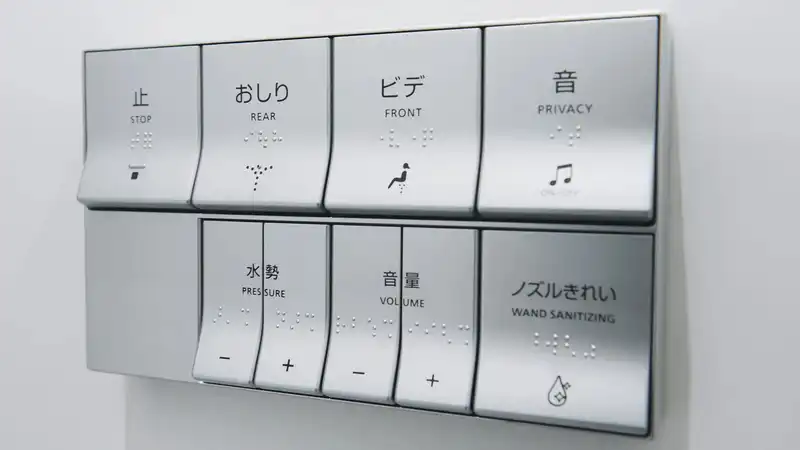
- Oshiri (おしり): This button activates the rear wash, providing a stream of water to clean the user’s bottom.
- Bidet (ビデ): Generally understood as a front spray for women, though anyone can use it.
- Suisei (水勢): Pressure adjustment buttons with plus (+) and minus (-) symbols allow you to increase or decrease the water pressure of the spray.
- Nozuru-sōji (ノズルそうじ): This nozzle-cleaning button cleans the bidet nozzle, often with a warm water spray, for hygienic purposes.
- Tome (止): A (sometimes red) button “stop” that immediately stops any of the washing or drying functions.
- Kansou (乾燥): This button activates the warm air dryer, used to dry “that” area after washing.
Flushing, if not automatic, is typically done using a lever (somewhere), or sometimes the control panel has a button for it.
Some also offer a feature to move the spray forward and backward a bit. Nozzle cleaning and drying functions are not always available. Some toilets have more functions, typically on a wall-mounted panel. We’ve even seen one with built-in music functions and a pop-up cover that provided access to many customization features, including seat temperature, water temperature, and water pressure.
Customization features, when available, will likely be most helpful to you in places where you stay for an extended period, such as hotels. The fancy ones even offer customizable presets for up to 4 people, so you can have it just the way you like it.
Who that?
Don’t be surprised when you go into a bathroom, and things happen automagically. Some will detect movement and automatically open the lid. Others will detect an occupant and start “preparing.” After you sit down, a small stream of water is released all around the bowl to provide “Ultra Glide!” Likewise, a flush might be initiated when you get up.
About those sounds
Japanese toilets often include a “sound princess” (Oto-hime, 音/音姫) feature, a button or sensor that plays a recording of running water or other soothing sounds to mask the noises of using the toilet. This helps maintain privacy in public restrooms. The sound can be activated manually or automatically. There may be a button for ototeishi (音停止), which stops the sound. Another button you may find is the volume control (音量), which adjusts the volume of the sounds.
In some places, the button was absent, but a small fountain or other water feature was installed to perform the same function.